Body camera footage is expected to be released Thursday that may show what led to a fatal police shooting in south Minneapolis Wednesday evening. It was the first killing by Minneapolis police since George Floyd’s death on May 25 less than a mile away.
Minneapolis police say an officer fatally shot a man around 6:15 p.m. at a gas station near 36th Street East and Cedar Avenue in south Minneapolis.
Minneapolis police spokesperson John Elder said the man, who hasn’t been identified, was killed after shots were “exchanged.” Elder told reporters that police suspected the man of a felony, although he didn’t specify what sort of felony. Chief Medaria Arradondo said later that witnesses saw the man shoot first at Minneapolis police.
The man will be identified by the Hennepin County Medical Examiner’s office. A woman who was in a vehicle with him was not injured. No police officers were injured.
Arradondo said late Wednesday that he planned to release the body camera footage Thursday.
"I want our communities to see that, so that they can see for themselves,” Arradondo said. “We can move forward from there."
The Minnesota Bureau of Criminal Apprehension is investigating the killing. The agency will release more information about the incident and identify the involved officers after talking to them.
Arradondo also asked the community for patience as investigators collected evidence, saying that his department would protect people’s right to freely assemble but that “we can’t allow for destructive, criminal behavior.”


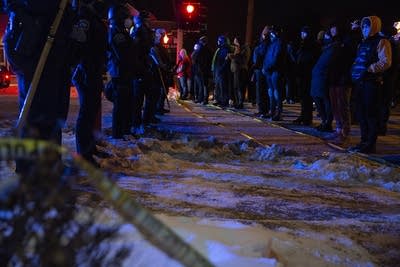
Police diverted traffic off of Cedar Avenue soon after the shooting, taping off the gas station. Residents and protesters began gathering soon after, blocking off nearby streets with vehicles. Many in the crowd chanted anti-police slogans. Some confronted the officers stationed around the gas station, where investigators were collecting evidence from the shooting.
The gas station where the man was killed is about a dozen blocks from what protesters have deemed “George Floyd’s Square.” Some protesters came directly from the occupation of that intersection.
Although the tone of the protests was angry, there was no violence directed at people by either protesters or police. Protesters played music and chanted from speakers mounted in a van. They warmed themselves around a bonfire in the middle of the intersection. Just before midnight, the van led many of the remaining protesters down closed off Cedar Avenue, and others dispersed later on their own. No arrests were reported at the site.
On Thursday morning, the site of the shooting was relatively quiet, although police tape and some candles that had been set up in memorial remained.
The police officers involved in the shooting were part of a “community response team,” which Elder said had been investigating a recent surge of carjackings in the city.
Carjackings, shootings and homicides in the city have jumped significantly since last year. The number of killings has reached levels not seen in nearly 25 years.
The shooting at 36th and Cedar comes more than seven months after then-officer Derek Chauvin kept his knee on the neck of George Floyd for around nine minutes. Floyd’s death sparked peaceful daytime protests and nights of looting and arson in the Twin Cities. Hundreds of buildings were damaged, including the Minneapolis Police Department’s 3rd Precinct building, which was set on fire.
Chauvin and three other officers were fired and have been charged with murder and manslaughter in Floyd’s killing. Their trial is set to start in March.
In the weeks that followed Floyd’s death, members of the Minneapolis City Council announced plans to overhaul the police department, or as one council member put it, to end the system of policing “as we know it.”
The council sent a proposal to the city’s charter commission that would have allowed voters to decide if the police department should be defunded, dismantled and replaced with another agency. The proposal failed to make it on the November ballot when the charter commission decided to take more time to consider it.
That didn’t prevent the council from making changes to the police department. During the 2021 budget mark up the council cut nearly $8 million from the police and shifted it to non law enforcement-based violence prevention programs and initiatives.
Mayor Jacob Frey and Chief Arradondo have also continued to make reforms to department policies and procedures. They include restrictions on so-called “no-knock” warrants and most recently, the mayor announced changes to how the city investigates police misconduct complaints.
This is a developing story. Check back for updates.